How to Convert Clip-In Clients to Permanent Extensions: The No-Commitment Pitch That Works
How to Convert Clip-In Clients to Permanent Extensions: The No-Commitment Pitch That Works
Clip-in wearers represent the highest-intent, lowest-resistance segment in any extension stylist's potential client base. They already understand the value of extensions, they've already accepted the price point for the look, and they've already identified a styling gap they want to fill. Converting clip-in clients to permanent extensions is not a sales conversation — it's a service upgrade conversation, and the professionals handling it most effectively are doing it with a specific three-phase approach that removes the perceived risk almost entirely.
What You'll Be Able to Do After Reading This
By the end of this article, you will have a repeatable consultation framework for introducing permanent extension options to clip-in clients, including what to say at each phase, how to stage the trial experience, and what follow-up timing drives the highest conversion rate.
What You Need Before Starting
- A clip-in client with at least 3 visits on record (pattern-of-interest is established)
- A matched color ring set for consultation — matching precision is the single biggest factor in first-time permanent extension trust
- At least two method options to present (tape-in and genius weft cover the majority of clip-in conversion candidates)
- A clear service menu showing the cost-per-month breakdown for permanent extensions vs. the time cost of daily clip-in styling
Step 1: Identify the Clip-In Frustration Point
Before you present any permanent option, you need to know which specific friction the client experiences with their current routine. The three most common: time (daily install and removal), consistency (clips shifting during the day), and occasion limits (not wearing their extensions to the gym, beach, or overnight).
Ask directly at the start of the appointment: "What's the one thing about your current clip-ins you'd change if you could?" Most clients answer immediately. The answer tells you which permanent method to lead with — someone frustrated by time is a tape-in candidate; someone frustrated by occasion limits is a genius weft candidate because the install lasts 6-8 weeks with no daily maintenance.
Common mistake at this step: jumping to the solution before confirming the problem. A client who says "they take forever to put in every morning" is not interested in a 3-hour genius weft installation right now. They want the simplest permanent option that solves the morning routine. Present tape-ins at $400-$700 for a full application, maintenance every 6-8 weeks. Match the pitch to the frustration.
How you know it worked: the client answers the question without prompting and the answer is specific. "The clips slip every time I work out" is actionable. "I don't know, they're fine" means you need a different entry point.
Step 2: Run the Trial Extension Experience
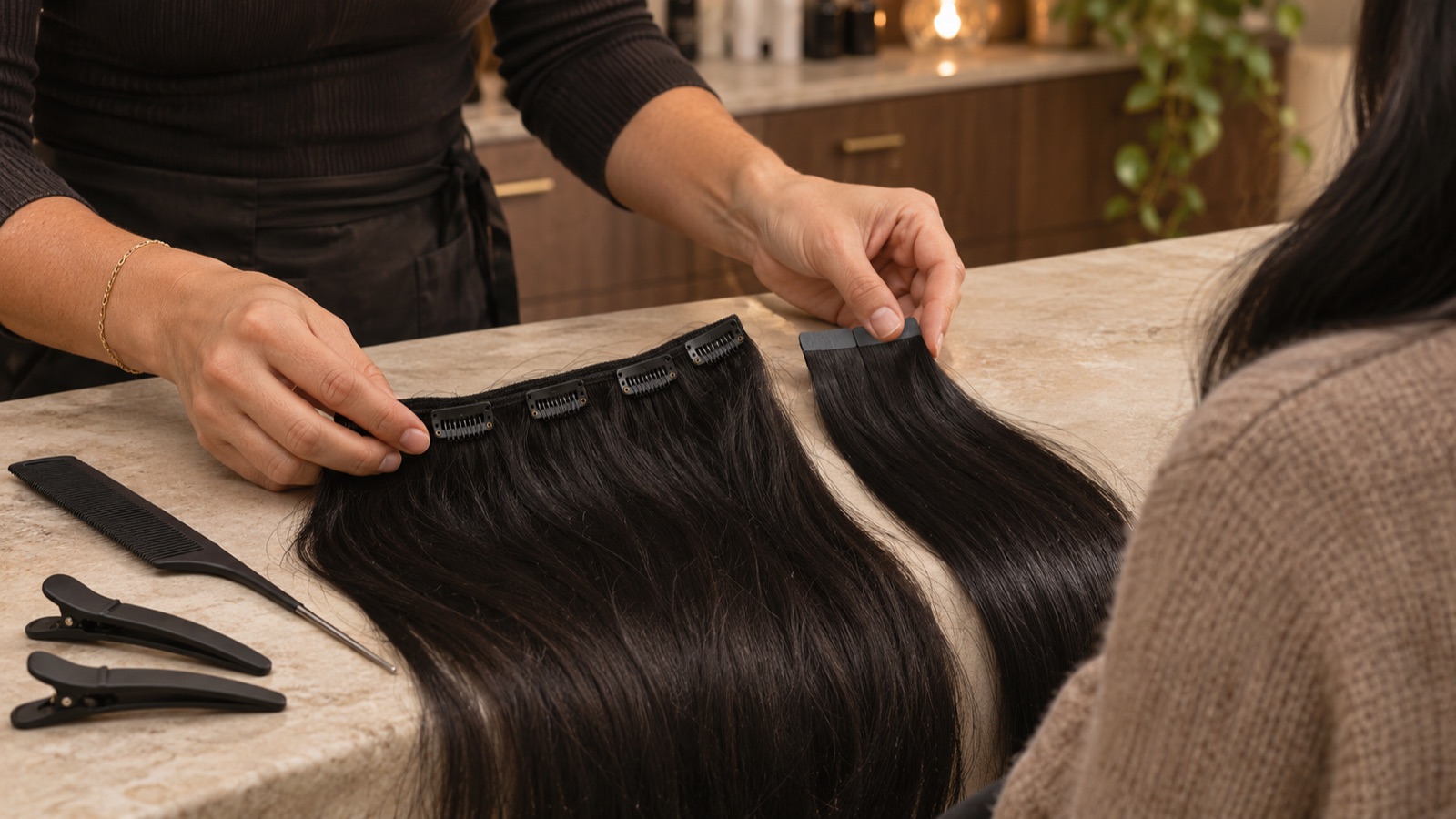
The highest-conversion technique in clip-in-to-permanent transition is what extension specialists in the professional trade call the "seated trial" — placing two to four permanent extension wefts or bonds in the client's hair during the consultation itself, letting them wear the extensions for the duration of the appointment, and then offering to remove them at the end if the client is not ready to commit.
This approach addresses the primary objection to permanent extensions: "What if I don't like it?" The client discovers in a 45-minute appointment what two years of clip-in wearing couldn't tell them — that professional permanent extensions feel different from clip-ins (lighter, more integrated, more secure) and that the experience of having them in is qualitatively better than the daily install routine.
The cost-of-trial framing matters here: "I want to put in four wefts so you can feel the difference. There's no commitment — if you leave today and don't want to continue, we're done. But I want you to feel what we're talking about before you decide." Most clients do not ask to have the trial wefts removed. Most clients who go through a properly executed seated trial do not ask to have the trial wefts removed.
Common mistake at this step: using lower-quality trial hair. The seated trial is the client's first impression of permanent extensions. If the trial hair is mismatched, coarse, or poorly blended, the trial proves the wrong thing. Use the same quality you would install permanently. The trial cost is worth the conversion rate it produces.
Step 3: Present the Cost-Per-Month Comparison, Not the Total Install Price
The psychological barrier to permanent extensions for a clip-in client is almost never the quality or the experience. It's the upfront number. A client accustomed to paying $150-$350 for a set of clip-ins looks at a $900 genius weft installation price and experiences sticker shock, even though the cost-per-wear calculus strongly favors the permanent option.
The reframe: "Your clip-ins cost you $250 a set and you replace them every 8-10 months. That's about $25 a month in product. But they take you 20-25 minutes every morning to put in and remove. If your time is worth $15 an hour, that's $75-$90 a month in time cost. Your genius weft installation is $900 amortized over 6 months before it needs a full refresh — that's $150 a month, total. No morning routine, no daily install, no clip slippage." That framing brings the decision into range.
Extension specialists report that the cost-per-month framing is most effective when the client's clip-in habit is already a daily one. For occasional clip-in wearers, the argument is weaker — the daily maintenance cost is lower. Identify which pattern applies before choosing your framing.
Common mistake at this step: presenting only the highest-tier option. A client who is genuinely interested in permanent extensions but has a fixed budget will disengage if tape-ins are not offered alongside genius wefts. Present both. "We can do a tape-in application for $450-$650 depending on the weight, and that's a 6-8 week maintenance schedule. If you want more coverage and longer maintenance windows, genius weft is $900-$1,200 and you're in every 6-8 weeks for a move-up, not a full reinstall." Let the client choose the tier that fits their life.
Step 4: Handle the "What If I Want to Go Back?" Objection
The most common objection from long-term clip-in clients is reversibility: they worry that committing to permanent extensions means they cannot return to their natural hair. This is a legitimate concern that requires a direct, accurate answer — not reassurance.
Tape-in extensions are fully reversible in a single removal appointment, with no damage to natural hair when removed correctly. Keratin bonds require a proper bond-dissolving removal process. Genius wefts, because they use no adhesive on the natural hair, are among the lowest-damage methods available. All three of these methods, when installed and removed by a trained professional, leave the client's natural hair in the same condition it was in before the install.
The "what if" objection is really a trust question: does this stylist know what they're doing, and will my natural hair be safe? The answer is delivered through your process, your consultation quality, and the evidence of your prior work — not through promises. Show before-and-afters of clients who have had permanent extensions for 18-24 months and are maintaining healthy natural hair underneath. That evidence closes the objection more effectively than any verbal reassurance.
Step 5: Close With a Soft Commitment, Not a Full Booking
After the seated trial and the cost comparison, the most effective close for clip-in-to-permanent conversion is a two-appointment path, not a same-day full booking. "Let's schedule your full consultation and color match for next week. That appointment is free, and it's the step before you decide whether to move forward." This structure gives the client a clear, low-risk next step that does not feel like a purchase decision.
The conversion from consultation booking to installation booking, when the consultation is properly executed, is high when the consultation is properly executed. The client who agrees to come back for a consultation has already made the psychological commitment. The consultation is where the match is confirmed, the final method is chosen, and the booking happens. Trying to close the full installation on the same day as the seated trial compresses the decision too much and produces more cancellations than direct bookings would.
How you know it worked: the client books the consultation before leaving the current appointment. A "I'll call to schedule" is not a conversion. "I want Tuesday at 3pm" is.
Troubleshooting: What Goes Wrong in Clip-In Conversion Conversations
The client is interested but won't commit: Return to the frustration point from Step 1. If the original frustration was mild, the urgency to change is low. For low-urgency clients, the conversion timeline is 2-3 consultations, not one. Plant the seed and follow up in 30 days.
The client has had a bad permanent extension experience with a previous stylist: Do not minimize this. Ask what happened specifically. The overwhelming majority of "bad extension" stories stylists encounter involve incorrect method selection, poor match quality, or maintenance neglect — not the extensions themselves. Walking through what went wrong and explaining what you do differently is the recovery. Clients who've had one bad experience and then go through a high-quality consultation with a new specialist often become the most loyal long-term clients.
The clip-in client has very fine or compromised natural hair: This is a legitimate method exclusion situation for some extension types, not a pitch problem. A client with fine natural hair may not be a genius weft candidate but may be an excellent tape-in candidate with a lighter application weight. The honest answer here — "I want to do a thorough health assessment before we choose a method, because fine hair requires a different approach" — builds more trust than the close.
Frequently Asked Questions About Converting Clip-In Clients
How long does the average clip-in-to-permanent conversion take from first conversation to booked installation?
For a client with an established clip-in habit and clear daily frustration, the average is 2-3 weeks from the first conversion conversation to a booked install. For clients who are curious but not yet frustrated, 6-8 weeks is typical, with the conversion triggered by a seasonal change or special event. Track these clients in your CRM with a "conversion candidate" tag and follow up at 30-day intervals.
Which permanent method converts best from clip-ins?
Tape-ins convert the highest volume — the price point is closest to premium clip-in sets and the method is fully reversible, which addresses the top objection. Genius wefts convert the highest-value clients — stylists charging $900-$1,400 per installation are generally working with clip-in clients who have already identified the look they want and are ready for the professional-grade version. Lead with tape-ins for volume; lead with genius wefts for average ticket size.
Should I offer a discount to convert a clip-in client?
No. Discount-based conversion attracts price-sensitive clients who will return to clip-ins when the discount expires. The conversion framework in this article is built on demonstrating value — the trial experience, the cost-per-month analysis, the quality of the consultation — not on price reduction. A well-executed seated trial is worth more than a first-installation discount and produces a more profitable long-term client relationship.
Clip-in-to-permanent conversion is not a closing skill. It's a consultation skill. The stylists with the highest conversion rates are not better salespeople — they're more thorough practitioners, and the thoroughness shows in every step of the process. The client who leaves your appointment understanding exactly what permanent extensions would look like, feel like, and cost them per month has already made most of the decision. Your job is to give them enough information to make it with confidence.