Hand-Tied vs Machine Weft: What the Installation Time Difference Costs You
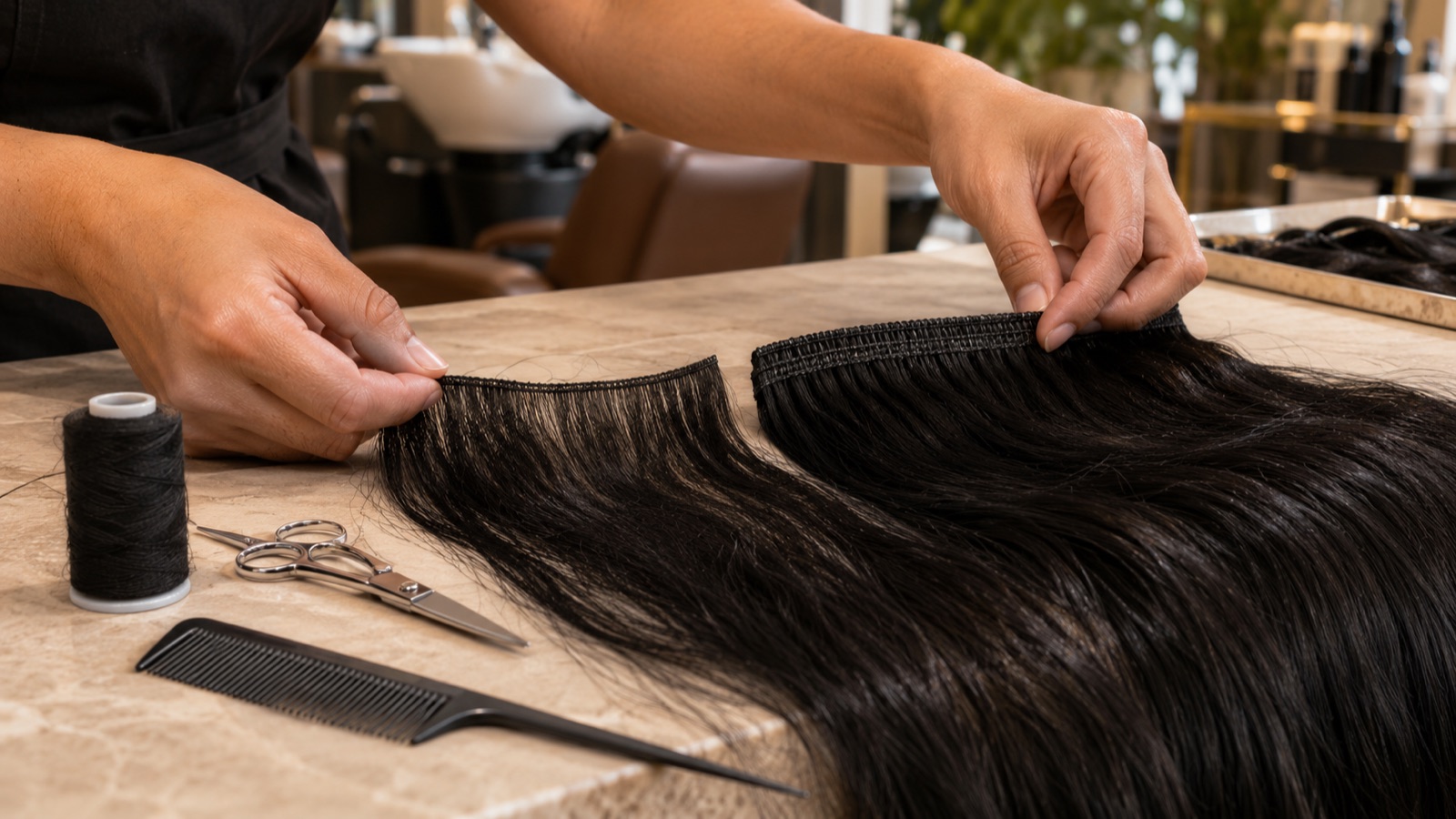
The labor math on hand-tied wefts does not work the same way it did three years ago. Installation costs have climbed in most markets while the time required has not meaningfully compressed, and the result is that stylists are running full hand-tied installs at a per-hour rate that undercuts their tape-in or tape weft work by 30 to 40 percent. Machine weft, historically dismissed as the budget option, is quietly absorbing clients who cannot afford the full hand-tied ticket.
Understanding what the installation time difference actually costs requires looking at both sides of the ledger: what you spend in chair time and what you capture in revenue per hour.
The Time Difference Is Larger Than Most Stylists Quote
The industry standard comparison is two hours for machine weft versus three to four for hand-tied. That understates the gap when you include setup and breakdown. A machine weft install on a client seeking full density typically runs 90 minutes to two hours including sectioning, weft prep, and finishing. A hand-tied weft install on the same client runs three and a half to five hours when you account for bead placement, row setting, weft cutting, sewing, and the knot-sealing step that most stylists add.
The move-up appointment gap is equally significant: machine weft move-ups run 45 to 75 minutes; hand-tied move-ups run 90 minutes to two and a half hours, depending on how many rows the client carries and how thoroughly the stylist removes and resets versus adjusting in place.
Extension specialists who track their chair time report an average of 1.8 to 2.4 additional hours per appointment cycle for a full hand-tied client compared to a machine weft client at equivalent density. Over a year, assuming five maintenance cycles, that is 9 to 12 hours of additional labor per client.
What Stylists Actually Charge — and the Gap That Exists
In markets where both methods are well-established (New York, Los Angeles, Nashville, Dallas), the price premium for hand-tied over machine weft installs averages 35 to 60 percent. A machine weft full install in these markets runs $600 to $900 for labor; hand-tied runs $900 to $1,600 for the same density goal. Move-up premiums are proportionally smaller: machine weft move-ups run $200 to $350, hand-tied runs $300 to $600.
The problem: the labor time premium is larger than the price premium. Charging 40 percent more for a method that takes 70 percent longer means the effective hourly rate on hand-tied work is lower. Data collected from extension-focused salons suggests the per-hour rate on hand-tied installs runs $175 to $225 in markets where machine weft installs yield $220 to $290 per hour at the same price point.
This is not an argument against hand-tied wefts. It is an argument for pricing them to reflect the actual time cost.
The Machine Weft Positioning Problem Stylists Are Getting Wrong
Machine weft has a positioning problem that is stylist-created. The method acquired a reputation as the entry-level option in the early 2010s when lower-quality machine-sewn wefts were being sold as a budget alternative to more labor-intensive installs. That quality gap has closed substantially: the machine weft construction on current generation wefts from quality suppliers produces comparable flatness, less shedding than earlier iterations, and installation results that are indistinguishable from hand-tied work to the untrained eye.
Stylists who continue to position machine weft as the inferior option are leaving a pricing correction on the table. The technically accurate framing is that machine weft and hand-tied weft are optimized for different client profiles and styling goals. Machine weft installs faster, costs the client less, and is fully appropriate for clients who want quality results without the premium for hand assembly. The stylist captures better hourly revenue on machine weft. This is not a concession; it is the correct recommendation for many clients.
Some stylists argue that hand-tied wefts are always the superior technical result, and in terms of flexibility and customization they are right about durability and adjustment capability. But they are wrong about who that superiority actually matters to. For a client who wears her extensions in high-volume blowout styles and is not a stylist herself, the difference is largely invisible. She is not paying for the construction method. She is paying for the result.
What the Time Difference Costs in Real Annual Revenue
Model the math on a ten-client extension book, five hand-tied and five machine weft, each client doing five maintenance cycles per year:
- Hand-tied: 5 clients x 5 appointments x average 3.5 hours = 87.5 hours/year
- Machine weft: 5 clients x 5 appointments x average 1.75 hours = 43.75 hours/year
The hand-tied book requires 43.75 additional hours per year to serve the same number of clients. At a market rate of $200 per hour, that is $8,750 in additional labor for the same client count. If the hand-tied premium over machine weft in your market is only $80 to $120 per appointment, the method mix decision is affecting your revenue per hour regardless of gross revenue.
The calculation changes if your market supports genuine hand-tied premiums. In markets where hand-tied installs run $1,400 or more and move-ups run $500 to $600, the effective hourly rate can match or exceed machine weft. Price your time, not the method's reputation.
What This Means for the Extension Market in 2026 and 2027
The segmentation that has been developing slowly for several years is accelerating. Clients who want the hand-tied result and can afford the full ticket are a stable market, but not a growing one at current price levels. The growth segment is clients who want quality extension results at a price point that machine weft enables. Salons that have built a machine weft service offering with clear quality positioning are capturing this demand. Salons that have not are watching it move elsewhere.
The specific prediction: by the end of 2027, the premium for hand-tied over machine weft installs will compress in mid-tier markets, driven by a combination of client price sensitivity and stylist recalibration of their time valuation. The stylists who benefit from this compression will be those who have already built machine weft into their service menu as a first-class option rather than a secondary one.
What to Do About It Now
Track your effective hourly rate by method, not your gross revenue per client. If hand-tied work is yielding a lower hourly rate than machine weft in your book, you have three options: raise hand-tied prices to reflect the time cost, convert clients where the method result is equivalent, or accept the rate differential as a premium service investment. Any of these is a defensible choice. What is not defensible is not knowing which situation you are in.
For stylists building a new book, the data increasingly supports a mixed-method practice: hand-tied for clients who need the flexibility or whose hair genuinely benefits from the customization, machine weft for clients where the result is equivalent and the time math serves both parties better. For a related breakdown of where tape weft fits into this landscape, see our earlier analysis of tape weft vs tape-in and what the method differences mean in practice and our piece on why the simplest extension installs are gaining ground in 2026.