Keratin Tip Convertible Fusion Tool: What It Does and Which Extensions Need It
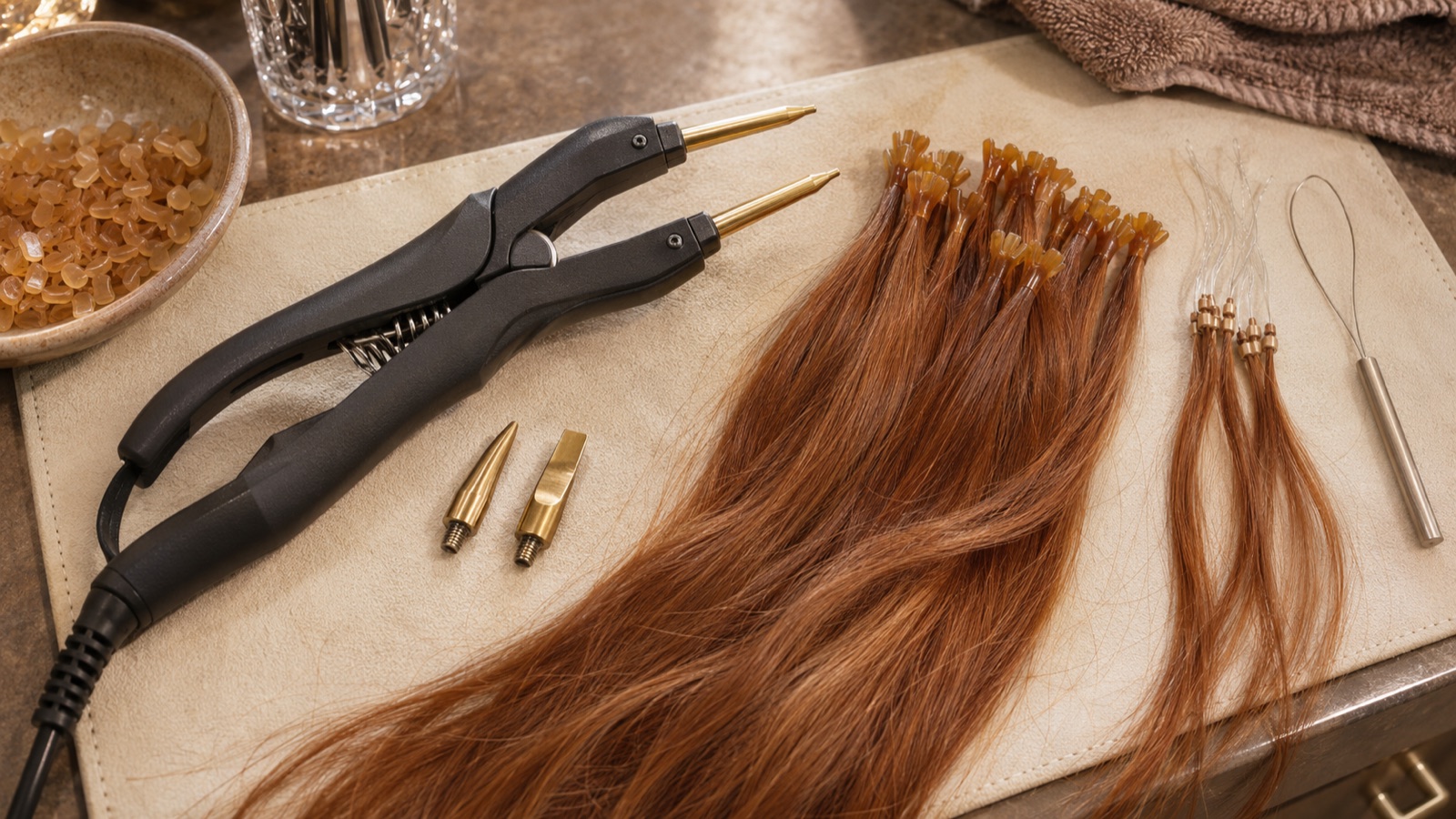
The keratin tip convertible fusion tool has become one of the more searched terms among stylists setting up k-tip and nano-ring extension services, yet the category remains poorly documented compared to the methods it supports. The tool is not a single product but a category: a fusion iron designed to melt keratin adhesive in multiple bond configurations, switching between attachment types via interchangeable tips rather than requiring a separate tool for each format. Understanding the distinction between a convertible fusion tool and a standard single-tip iron, what those tip configurations actually do, and which extension methods genuinely require each one makes the difference between a well-equipped service menu and a tool drawer full of overlapping inventory.
Convertible vs Standard Fusion Iron: What the Difference Actually Is
A standard fusion iron — the tool most stylists learn on during initial k-tip training — has a fixed tip geometry, typically a clamp-style connector calibrated for either straight keratin bonds (classic k-tip) or cylindrical nano-ring connections. It heats to between 300°F and 380°F depending on brand, melts the keratin tip when held in contact for 3 to 5 seconds, and the stylist rolls the melted bond smooth with their fingers or a tool-end roller. It handles one application type cleanly.
A convertible fusion tool uses the same heating element but ships with two or more interchangeable connector tips: typically a standard flat-clamp tip for classic k-tips, a round-jaw tip for nano-rings or micro-rings, and in some configurations a wand-style tip for hand-molding pre-tipped extensions. The core advantage is consistency of heat calibration across methods — stylists who offer both k-tip and nano-ring services report that matching temperature on a single calibrated device is more reliable than maintaining two irons with independently drifting thermostats. The practical disadvantage is that tip swaps take 30 to 60 seconds mid-application, which adds up on high-volume installs where workflow efficiency is the primary variable.
Which Extension Methods Actually Require a Fusion Tool
Fusion tools are required for any application format where keratin adhesive must be thermally activated at the connection point: classic k-tips, nano-rings with a keratin pre-tip, and some hybrid micro-tip formats. They are not used for tape-in applications (which use adhesive already applied to the extension), hand-tied wefts (which are beaded or sewn), or clip-in installs. The convertible configuration matters specifically in salons offering both classic k-tip and nano-ring services on the same day — the interchangeable tip means the stylist can run a k-tip install in the morning and a nano-ring session in the afternoon without maintaining two separately heated irons.
Some manufacturers market their convertible tools as compatible with fusion-style weft attachments, where a thin pre-tipped strip of weft is bonded to a micro-row rather than installed as a bead. This application is less common in North American salons than in European and Australian markets, where micro-fusion weft formats have broader adoption. Extension specialists offering these formats report that the wand-style tip on convertible tools gives more controlled bond shaping than a standard clamp, but the learning curve on temperature calibration for these thinner bond formats is steeper than for classic k-tips.
Temperature Ranges and Why They Matter More Than Brand
The most consequential specification on any fusion tool is not the brand name but the temperature control range and accuracy. Keratin adhesive melts cleanly between 300°F and 360°F; above 380°F, the adhesive becomes too fluid to roll into a controlled bond shape and risks flowing onto the client's natural hair. Below 280°F, the adhesive does not melt fully, producing a bond that looks set but has not fully polymerized and will slip under load faster than a correctly applied connection.
Cheaper fusion tools, including several frequently discussed in online stylist communities, claim a fixed temperature that is accurate at calibration but drifts significantly under sustained use. A tool that reads 340°F in the first 10 minutes of use and 390°F after 45 minutes of continuous installs is not a precision instrument — it is a liability on a long installation day. Professional-grade convertible tools, which typically retail between $120 and $280 depending on the number of included tips, use ceramic heating elements with thermal sensors that maintain calibrated temperature within a tighter window across extended use.
The rise of tool-focused extension brands like those discussed in Weft Mag's coverage of the Big Kizzy tool category has brought more options into this space at lower price points — but the temperature drift issue applies specifically to lower-cost models from newer entrants. The tool category has not yet standardized third-party temperature testing, which means stylist forum recommendations are the primary information source and those recommendations often do not account for sustained-use performance versus cold-start accuracy.
What to Look for in a Convertible Fusion Tool: The Working Criteria
Extension specialists surveying the convertible tool market report the following as the criteria that determine real-world performance, in order of importance:
- Tip retention security: The connection between the interchangeable tip and the heating element must be mechanically positive — a tip that wobbles or self-loosens mid-install creates inconsistent bond pressure and increases the risk of thermal contact with the client's scalp. Magnetic tip retention systems are more convenient but have a worse track record for wobble than threaded or lever-lock systems.
- Sustained temperature accuracy: Test any new tool at 20 minutes of continuous use, not just at startup. A basic infrared thermometer pointed at the tip surface gives an independent reading against the tool's display.
- Tip geometry for primary method: If 80% of a stylist's fusion work is classic k-tip, the flat-clamp tip should be the primary configuration, not an accessory. Some convertible tools are designed around the wand configuration and treat the flat-clamp as secondary.
- Cord length and swivel: Most fusion installs require working in a 270-degree arc around the client's head. A short, non-swivel cord creates fatigue on three-hour installs. This sounds minor until a stylist has run six consecutive nano-ring applications with a rotating wrist cramp.
The Honest Case Against Convertible Tools for Single-Method Stylists
For stylists who offer only classic k-tip applications — a majority of extension specialists in North America — a convertible fusion tool is unnecessary overhead. A calibrated single-tip iron bought from a reputable manufacturer, maintained correctly, and replaced on a two-year cycle is a more cost-efficient and lower-maintenance option. The convertible format's value proposition is specifically about method diversity: a stylist adding nano-ring or hybrid micro-fusion services to an existing k-tip menu benefits from the tool in a way a single-method stylist does not.
The conversion question is also relevant to ongoing certification. As covered in Weft Mag's earlier reporting on in-person vs online extension education, the mechanics of fusion tool application are one of the competencies that training programs assess in person — and the convertible tool's switching mechanism is one of the technique elements that benefits from hands-on instruction rather than video demonstration.
Frequently Asked Questions: Keratin Tip Fusion Tools
What is a keratin tip convertible fusion tool?
A keratin tip convertible fusion tool is a heated bonding iron designed for applying keratin-tipped hair extensions, with interchangeable tip attachments that allow it to handle multiple bond formats — typically classic k-tip, nano-ring, and micro-fusion configurations — from a single heated base unit.
What temperature should a fusion tool be set to for k-tip extensions?
Most k-tip applications run cleanly between 310°F and 360°F. The lower end works for fine or color-treated natural hair where thermal protection matters; the upper end is appropriate for coarse natural hair where the bond needs more heat to set fully. Above 380°F, the adhesive becomes too fluid to control. These ranges assume correct tool calibration — verify with a contact thermometer if the tool is new or has not been calibrated recently.
Is a convertible fusion tool worth it for a single extension method?
For stylists offering only one fusion method, a standard single-tip iron is the better value. The convertible format adds cost and tip-swap complexity that does not pay off unless the stylist is actively using at least two bond formats in their service menu.
How long does a professional fusion tool last?
With regular use (4 to 6 applications per week), a professional-grade fusion tool from a reputable manufacturer typically operates within calibration for 18 to 30 months. Temperature drift, tip wear, and cord failure are the primary failure modes. Replacing on a two-year cycle, or when a contact thermometer shows the tool reading more than 15°F off its display setting, is the industry standard recommendation across extension training programs.